
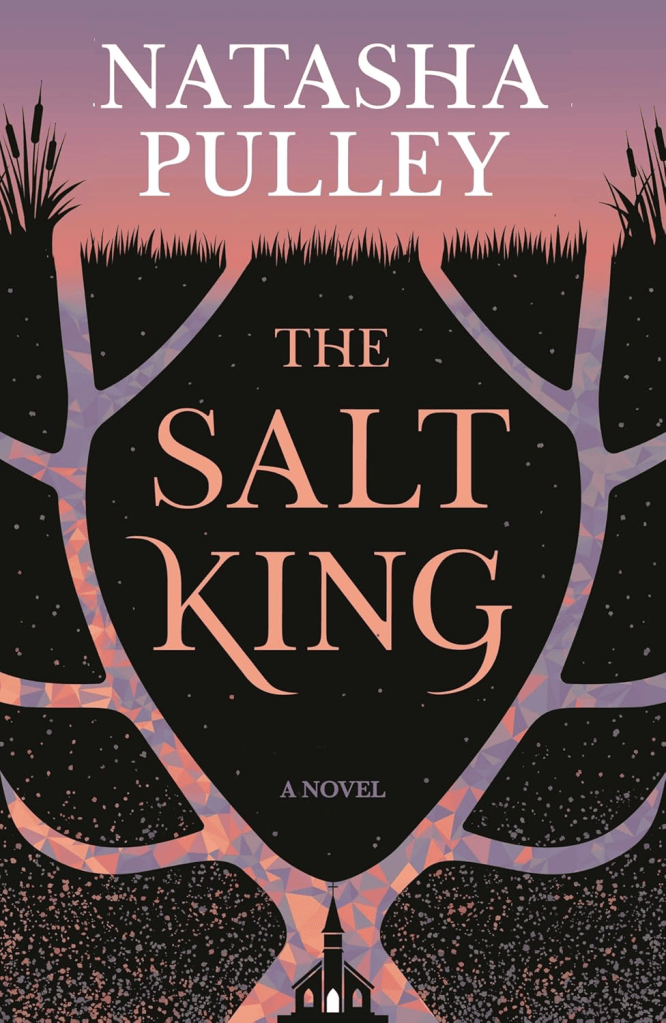
At age sixteen, Avelyn fled his small isolated hometown of Hreodwater—home to a salt mine and a culture that lives, breathes, and speaks the mythology of their Salt King—and ran off to become a Jesuit priest at the Vatican in desperate
search of guidance and the nurturing embrace of the God he left behind. Twelve years later, Avelyn is called back to Hreodwater when another priest visiting the town inexplicably turns to salt. Upon his homecoming, Avelyn meets Jericho—a mysterious doctor who has an understanding of Hreodwater that should be impossible for an Outsider—and the two join forces to make sense of the strange changes happening in the mines and, increasingly, all over the world.
Anyone who knows me will tell you that I simply do not shut up about books that I like, and that’s true. Usually, when I love a book I want to tell everyone about it (read: shove it in their faces) so that they can read it and love it too. However, there are also certain books that I love in a way that makes them very difficult to talk about, because they’re just something else. Natasha Pulley is easily one of my favorite authors and several of her books fall into this category, including The Salt King, but I’ll do my best.
Pulley’s books are so magical, that they actually make me angry. I’m mad because:
1. Why can’t I live in a world that is as magical, even when it’s terrible, as this one?
2. Why can’t every book be like this? and
3. Why can I only experience this book for the first time once?
The Salt King is more horror leaning than any of her other books, maybe The Half-Life of Valery K gets the closest, and yet it is the most enchanting horror story you’ll ever read. I talked about this in an essay, but it is the magic that makes the horror so truly disturbing. It’s so much more unsettling that the same force that lights up the An El cathedral with spectacular images and can miraculously heal people can also turn birds into bricks of salt mid-flight and bring nightmares to life, rather than if it were some wholly ugly force of intentional evil. Avelyn’s world is magical enough to be so much more wondrous than our own and terrible enough that it makes sense, in the way that our world also has potential for great beauty and great horror.
The book explores faith and belief from a lot of different angles, but in both the Dedication and the Acknowledgements Pulley alludes to the fact that faith (at least in the religious sense) is not something she can really experience or understand. She also mentions that for people who do experience and understand it, they can’t imagine what it’s like not to. I also don’t understand faith at all and don’t think I would have even if I had been raised with more religious surroundings. I am maybe a particularly bad case, because I don’t believe in God but I also don’t confidently believe that God does not exist. Frankly, I’m not sure it’s any of my business. (I don’t even think I ever believed in Santa Claus. I vividly remember being maybe five or six and tearfully asking my sister if Santa was real, not because I believed and was having doubts but because I was trying to figure out if I was the only one who didn’t believe in the slightest, worried that there was something wrong with me. She surely knew by then that Santa was not real but tried to assure me that he was, which was nice of her but in my case did not help the situation.)
Sometimes we treat faith like it’s a muscle you can exercise, and that with enough time and practice or a strong enough influence, anyone can become a believer. Honestly, I think it’s more of a personality trait that you’re born with, like being curious or assertive or loyal, and if you aren’t born as a faithful person you’re just kind of left in a godless world. In the opposite direction, a lot of the time people who join extremist groups or cult religions (cult is a nebulous term but you know what I mean), those people are often also current or former members of a religion. I think if you are born a faithful person, it’s hard to live without something to believe in, so even if you decide the church you grew up in was too toxic you might be inclined to find something else to have faith in.
Avelyn falls into kind of an interesting grey area. Worship of the Salt King doesn’t necessarily require the faith that believing in the Christian God does because the Salt King is a lot more tangible, at least to the Hreod people. When Avelyn leaves, be joins the Church because he seeks the same kind of wholeness and love he got from the Salt King, but he’s disappointed by how hands-off God is and can never really feel faith. In this way, Avelyn is very much a believer but isn’t very faithful, and there are a lot of discussions between him and Jericho and him and Father Li teasing out how different people manifest faith and belief. There’s a lot more to the role of belief in the story, but in the interest of keeping this spoiler-free I won’t go any further.
As usual with Pulley’s books, there’s just a touch of romance and somehow it’s still the most intensely-yearning, heart-rending, soul-crushingly epic love story (or really, two love stories). I always enjoy that the pairings are kind of complicated and messy without the idealism you find in a lot of romances because it just adds flavor to the story and the characters and doesn’t feel forced. I love Pulley’s writing across the board, but the way she writes love and emotional intimacy always gets me. It’s done with such a light hand that every little touch or glance feels momentous.
While I’m talking about the writing, there were so many passages that just blew me away. I was reading the ARC on Thorium which is a reader that does not allow you to highlight and save lines like you can on Kindle, so I just took screenshots of all of my favorites and now I have a folder on my computer with like thirty screenshots of this book. I might need to get an ebook copy after it releases anyway just to get those lines saved properly.
Don’t ask me about the plot. I don’t know what the hell was happening and I couldn’t describe it to you if I tried, but when you’re reading it, it all makes sense.
Natasha Pulley has yet to disappoint and as usual I’m absolutely dreading the time I will have to wait for her next release, but I’ll be seeing her on her US tour in a few weeks and I can’t wait!
Thank you to Natasha Pulley and Bloomsbury Publishing for this ARC in exchange for my full, honest review!
Happy reading!
Recent posts:


Leave a Reply