
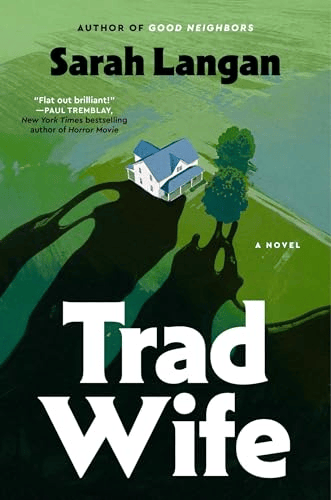
With her career on a sudden downturn, journalist Jenny Kaplan accepts an assignment to write about Mia Wright, a trad wife influencer living on an isolated farm with her beautiful husband and seven children.Jenny goes
in expecting to write a critical article exposing the disparity between Mia’s actual life and the life she show on social media, but it soon becomes clear that there are much darker happenings at Black Swan Farm and Jenny might be putting much more than her career at risk.
This started off really solid. It’s a little slow-paced in the first part but it picks up eventually, and Langan does a good job setting up how Jenny’s life is such a mess that she’s willing to put up with the weirdness of Black Swan Farm. It’s also a nice touch that part of Mia Wright’s persona is being clumsy and flawed (though that too is a false front), so it’s easy to imagine why she especially would rise to the top. She has balanced the perfect visuals and wholesomeness of the trad wife aesthetic with just enough humanity that fans can relate to her and haters can hate-watch to see every time she screws up. There are several otherwise reasonable characters in the story who are big fans of Mia Wright like Jenny’s sister, and that feels believable to me in a way that it wouldn’t if Mia’s persona was entirely perfect.
*sigh* And then this book does something I can’t stand and just devolves into fever-dream nonsense. This isn’t a new thing in horror by any means in fact it’s kind of a staple of the gothic genre, but I feel like I’ve been reading more and more horror that just ends in confusing half-dream sequences in which the stakes are unclear and anything can happen without consequence. I understand that this is reflective of a deteriorating mental state, but I don’t care—it’s infuriating and it immediately causes me to lose all steam in the book. It’s not fun for me to read from the perspective of characters that are drunk or high or hallucinating, because when anything can happen the actual narrative is lost completely. It also kind of ruins the ability to get a thematic point across because any of the plot threads exploring misogyny and bodily autonomy get lost in the sauce.
I also think there were just a bunch of concepts shoved into this that never really fit together. The premise of “Trad Wife is able to appear perfect because she is utilizing the power of some dark entity that can’t really be controlled” is great on its own, but then there’s all of this stuff about the Sylvan Six and Corrie’s Fire and the yellow fog and they all feel like separate ideas that aren’t really contributing to the story. Looking back on it, the premise sounds like horror but it didn’t feel like horror when I was reading it. It’s kind of strange and unsettling on the whole but it’s not actually scary or very tense.
Trad Wife started with some great ideas, and I just wish it had edited them down to focus on the important stuff and followed through to the end instead of taking (in my opinion) the lazy route and descending into surreality. If you like descents into madness, witches, and fever-dreamy books I think you’d like this a lot more than I did.
Thank you to Sarah Langan and Atria Books for this ARC in exchange for my full, honest review!
Happy reading!
Recent posts:


Leave a Reply